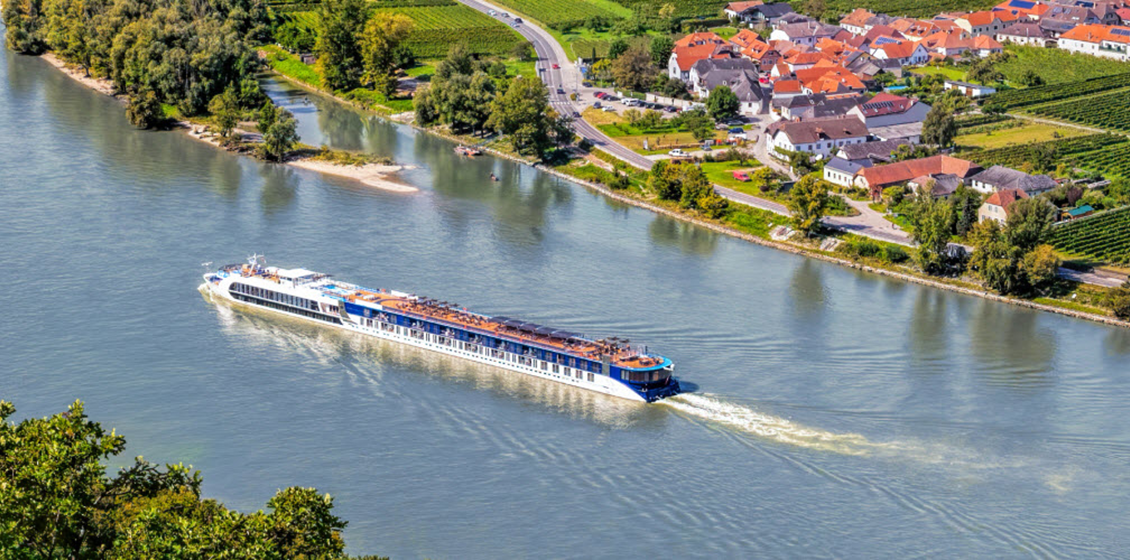
Atlas Ocean Voyages is assessing a new expedition ship design, as the high-end small ship operator prepares to broaden its reach in the Australian market.
Speaking exclusively with LATTEthis week from the Caribbean, James Rodriguez, President of Atlas Ocean Voyages revealed plans are evolving for the design of new polar ships, offering guests something different to the brand’s current fleet of three sister ships.
Atlas Ocean Expeditions remains a relatively young cruise brand in the expedition market. Originally announced by its owners pre-pandemic in 2019, the first ship World Navigator launched in August 2021 in the Middle East, and sister ship, World Traveller joined a year later in 2022. It was in August of 2022 that Rodriguez joined Atlas Ocean Voyages, which still had another three ships scheduled to join the brand over the coming years.
Since November 2022, Atlas Ocean has had two of its 198-guest vessels in Antarctica. Following a successful initial season of dual ships sailing to the White Continent, a third vessel was pulled from sister-brand Niko Cruises’ fleet, World Voyager, to ramp up capacity even further.
Beyond Antarctic voyages between November and March, the Atlas fleet makes their way north to Europe. One vessel heads to the Arctic to operate traditional expeditions, another operates in Northern Europe, the British Isles and Stockholm, and the third vessel sails the Mediterranean, offering Atlas Ocean Voyages’ Epicurean Expeditions, centred on the culinary offering of the region.
“It wasn’t until 2023 that Atlas Ocean Voyages began hitting its stride, with a its first full year of sailing,” Rodriguez explained.
“We received a third vessel, quite unexpectedly and quickly, and had to sell those cabins.”
Under Rodriguez’s guidance, the brand evolved, cabins began to fill, and revenue started to rise.
“We came from single digit occupancies when I started here in August of 2022. We had quite a hurdle to overcome,” he told LATTE.
“In the 2022/23 Antarctica season we were able to end the season with 88% occupancy, just in a short amount of time.
“We implemented some quick sales and marketing tactics, called on some travel partners for support, and they delivered. We were very happy to end with occupancy of 88%”
“At the cost of yield, because we were late to the game and trying to fill the vessels, but we quickly recovered after that. Since then, we’ve had nearly a 35% increase in yields from 2023 up to the end of the 2024/25 Antartica season. Yield for Antarctica was even stronger, up nearly 40%.”
Luxury cruise/Expedition cruise sector
Atlas Ocean Voyages came into the market when there was a massive influx in expedition cruise ships and new operators to the space. Rodriguez says one of the “key differentiators” for Atlas was the brand’s hybrid model, positioned between the luxury cruise experience and the expedition cruise experience.
According to Rodriguez, a large portion of guests to the brand are couples where one is an adventurer and their significant other may not be.
“We straddle the two, where you can have both. Both experiences, with our space experience and we have ways that guests are able to engage with the lands, through our water’s edge areas, just 30 feet away from the land.”
There are heavy expedition players in the market where they are travelling to do science, and there are people who really love that, and people who want a kind of hybrid of both. They want the the cruise experience and they want the expedition experience.
Another differentiator is “we are are a year round expedition company. Every one of our expeditions are programmed as an expedition.” That involves taking off the expedition team and replacing them with an epicurean team (guest chefs, gastronomic guests) who specialise in cuisine in that part of the world.
“I was really taken with the expedition experience. I’ve been in the cruise business for over 20 years and it wasn’t until I took my first Antarctica expedition that I really realised there’s a difference between cruising and expedition-ing.”
“We identified three components to an expedition. There’s the educational part and learning about the wildlife, the whales, the animals, and we wanted to do the same in the Mediterranean where the guest learns about the grapes and the wines, the foods, the type of foods, from the paellas in Spain, to the pastas in Italy. So we really wanted to bring those areas to life. So the educational part, the immersive part – because the size of our vessels, we’re able to get in some of the smaller, out of the way ports where there’s not so many crowds. Our guests are very active, they want to immerse themselves in the places that they reach. So we are creating itineraries that allow for that to happen, with overnight stays and longer times in ports, into the evenings.
“And the third, more elusive third component to expedition is the inspirational element. And that comes from the expedition teams, engaging with guests, bringing areas to life, and creating bonds with guests. That really makes the crew special – and it’s a little different for us, because we want to program every one of our voyages as an expedition, whether you’re in the Med or you’re on the East Coast of South America, into the Caribbean.”
Australian market
Rodriguez says booking numbers from Australia have grown “quite exponentially” for a non-source market.
“We’ve only been sailing in Australia for less than a year, around 10 months. We’ve already sourced 450 guests from the region, so it was activated pretty quickly, pretty fast for us, but I’m not surprised because I think the style of cruising that we have really resonates with the Australian guest.”
The partnership between Atlas Ocean Voyages and Cruise Traveller means the product is showcased online to the Aussie traveller, and pricing is in Australian dollars.
“It’s been good for us. They’ve been a great partner of ours.”
He pinpointed the Australian cruiser was seeking a “casual, luxury experience where there’s not a lot of stuffiness for the onboard experience.”
New ship design
Initially, Atlas Ocean Voyages was envisioned to have a fleet of five ships, with other future ships including World Seeker and World Explorer, as well as World Discoverer. Last year, it was revealed that Seeker and Explorer had been sold to Windstar Cruises for its brand expansion.
Quizzed by LATTEif Atlas Ocean Voyages was now looking at future designs for expansion, Rodriguez said “We are, we’re in the process of working on that now.”
“The original plan for this line was to have five replica ships. Through experience, through practical sailing, we’ve now come to determine that we need a different class of vessel also to enter our fleet. To round out our offering. So that’s what we’re working on right now. There will not be five of the same vessels any longer, which is one of the reasons one of our vessels was sold because we plan to go in a different direction.
Instead of looking at a new class of ship, Rodriguez confirmed the new ship designs would remain ice-class.
“We’re all expedition and we really want to make sure that we stay in that region of the world.”